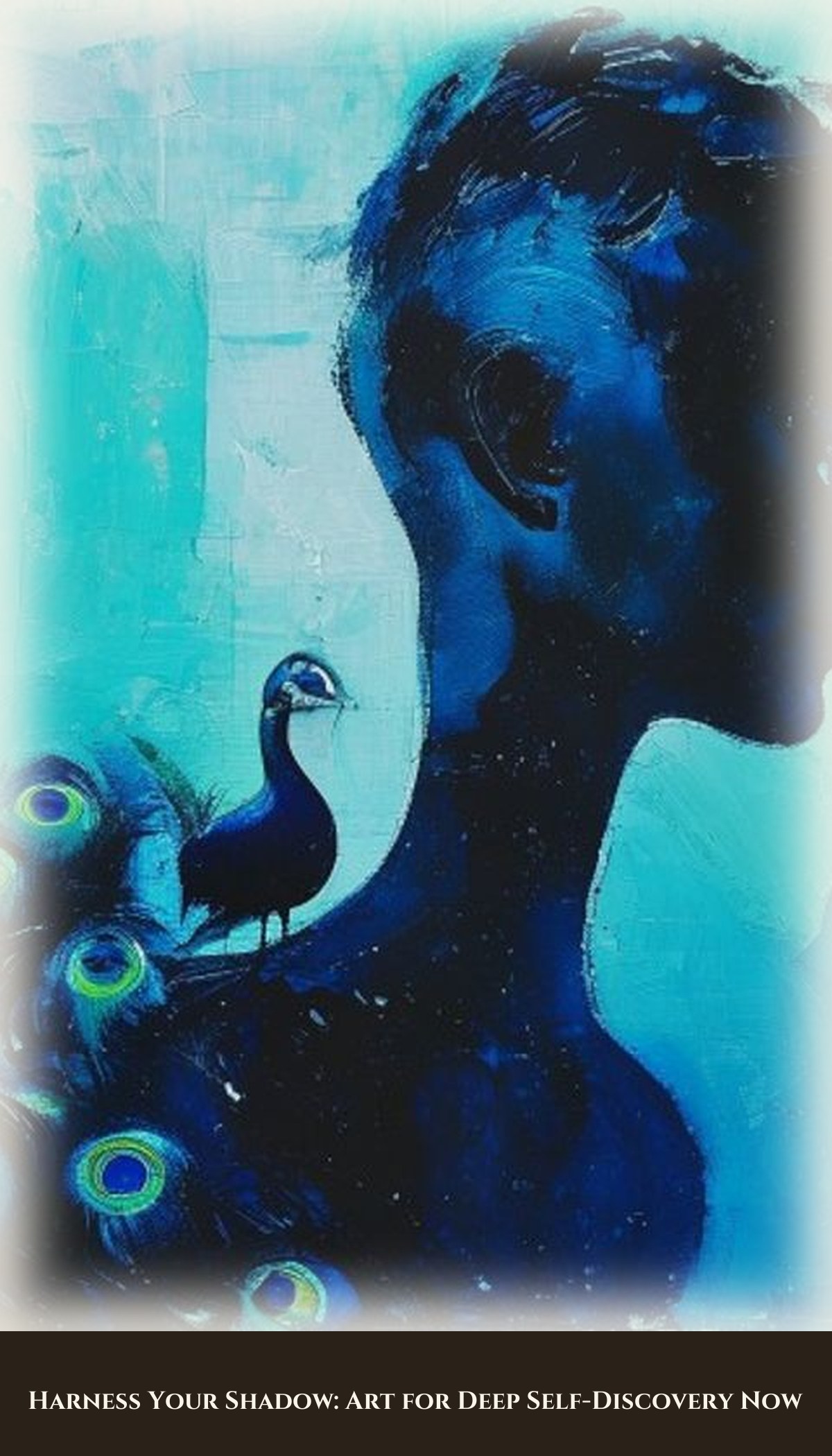
Harness Your Shadow: Art for Deep Self-Discovery Now

Harness Your Shadow: Art for Deep Self-Discovery Now

Staring at a blank canvas, knowing those murky feelings from your subconscious need an outlet but feeling utterly lost on how to actually translate them into something tangible for effective creative shadow work. The sheer weight of unspoken things makes even starting feel impossible. You recognize that the concepts around shadow integration are clear in theory—the necessity of confronting the unconscious emotions—but the gap between knowing and doing feels like a canyon. This difficulty in making the unseen visible is your current sticking point, isn't it? Most guides talk about doing shadow work, but they don't address this paralyzing moment right before creation begins. You are standing at the edge of deep self-discovery, armed with raw material that has no recognizable shape yet.
Stop viewing your recurring emotional patterns as a flaw in character; they are simply the established circuits of your inner landscape. Your perceived tendency toward certain emotional reactions is not a weakness to be corrected, but rather the current wiring diagram of your particular shadow archetype within the framework of depth psychology. Recognize this pattern—this predictable pull toward self-sabotage or overextension—as the unique signature of your current stage in shadow work. Instead of feeling shame for these familiar movements, install pride in recognizing their blueprint. View your inclination as a highly specific map detailing where your unconscious emotions are currently demanding attention. Understanding these ingrained patterns allows you to guide your creative expression for shadow work, transforming what feels like emotional baggage into tangible material through art therapy for shadow integration.
The mainstream narrative treats creative expression as mere hobbyism, a pleasant diversion disconnected from real psychological depth. They miss that this process is fundamentally about shadow work. Most people view art therapy for shadow integration as something you do when things get difficult, an afterthought rather than a core component of self-discovery. The sphere framework shows otherwise; it illuminates how tapping into creative expression acts as a direct conduit to the unconscious emotions. It suggests that using creativity in shadow work practices isn't just about making pretty things. Instead, it’s a precise mechanism for confronting what is repressed, offering powerful insights for personal growth. You are realizing that your most potent tool for true shadow integration is the very act of creation itself, something the conventional understanding consistently overlooks.
If you continue to treat your inner landscape as solely a source of vague discomfort, those murky feelings remain unaddressed energy. They accumulate, creating friction in your daily routines—a persistent sense of being slightly off-balance, like always carrying an invisible weight that saps your focus during important conversations or creative blocks. Ignoring the material means leaving it to dictate its own terms for expression. However, if you commit to channeling those subconscious currents through tangible art, something shifts. You begin to see those difficult emotions not as burdens, but as raw material. The act of giving form to what was previously shapeless allows you to gain perspective on your emotional baggage, moving toward a genuine sense of self-possession within your own making.
Book cover: Tired of playing small? You are not built for compliance. Your rebellion is your inherent law. If not now, when?
You might be surprised that the most resistant parts of your creative output—the images you immediately want to delete or the melodies you can’t quite finish—are actually holding your greatest potential. They aren't mistakes; they are encrypted messages from a part of yourself you haven't bothered talking to yet. Understanding this requires a shift in how you view 'finished.' Instead, try treating the initial friction, the urge to stop, as the actual subject matter for your next piece. If that feels too abstract right now, know that there are patterns waiting for you concerning The Aesthetics of Necessary Failure, Mapping Your Unspoken Rituals, and The Geometry of Resistance. For now, just let yourself notice where the sticking points occur in your process; that noticing is the work itself.
Right now, you can identify the emotional baggage that surfaces during your creative process, but there is a distinct space between simply acknowledging those shadows and feeling fully equipped to channel them into something genuinely vibrant and self-accepting. You have the raw material—the buried parts of yourself waiting for expression—but what you lack is the structural map connecting recognition to authentic artistic output. Imagine knowing precisely how to treat that difficult, unacknowledged energy source not as a threat to be managed, but as pure, usable pigment for your next piece. Understanding this gap means seeing the finished canvas: one where every perceived flaw or hidden memory has been consciously woven into something beautiful and undeniably yours. The full picture reveals a method for making that integration effortless.
Explore the complete guide to deepening your practice with the full Shadow Work toolkit now at transformation.press

Frequently Asked Questions

What exactly is 'shadow work' in the context of creativity?

Shadow work involves acknowledging and integrating the parts of yourself—feelings, desires, or traits—that you tend to repress or deny. Using creative expression allows you a safe outlet to explore these hidden aspects.

What kind of art forms are best for shadow integration?

There isn't one 'best' form; the most effective medium is usually what feels most authentic to you. Try journaling, painting, music, or even movement to see what resonates with your subconscious.

If I feel resistant while creating, is that part of my shadow?

Yes, resistance during the creative process can be a sign that you are approaching an unintegrated or difficult emotional area. Instead of fighting it, try observing the feeling without judgment.

How often should I use this technique for best results?

Consistency is key; aim to dedicate regular, non-judgmental time to your creative practice. Even short, focused sessions can build momentum for integration.

What if my art feels too dark or negative after shadow work?

It's normal for the initial output to be intense or difficult because you are bringing buried material to light. Remember that the goal is observation, not necessarily immediate 'fixing.'