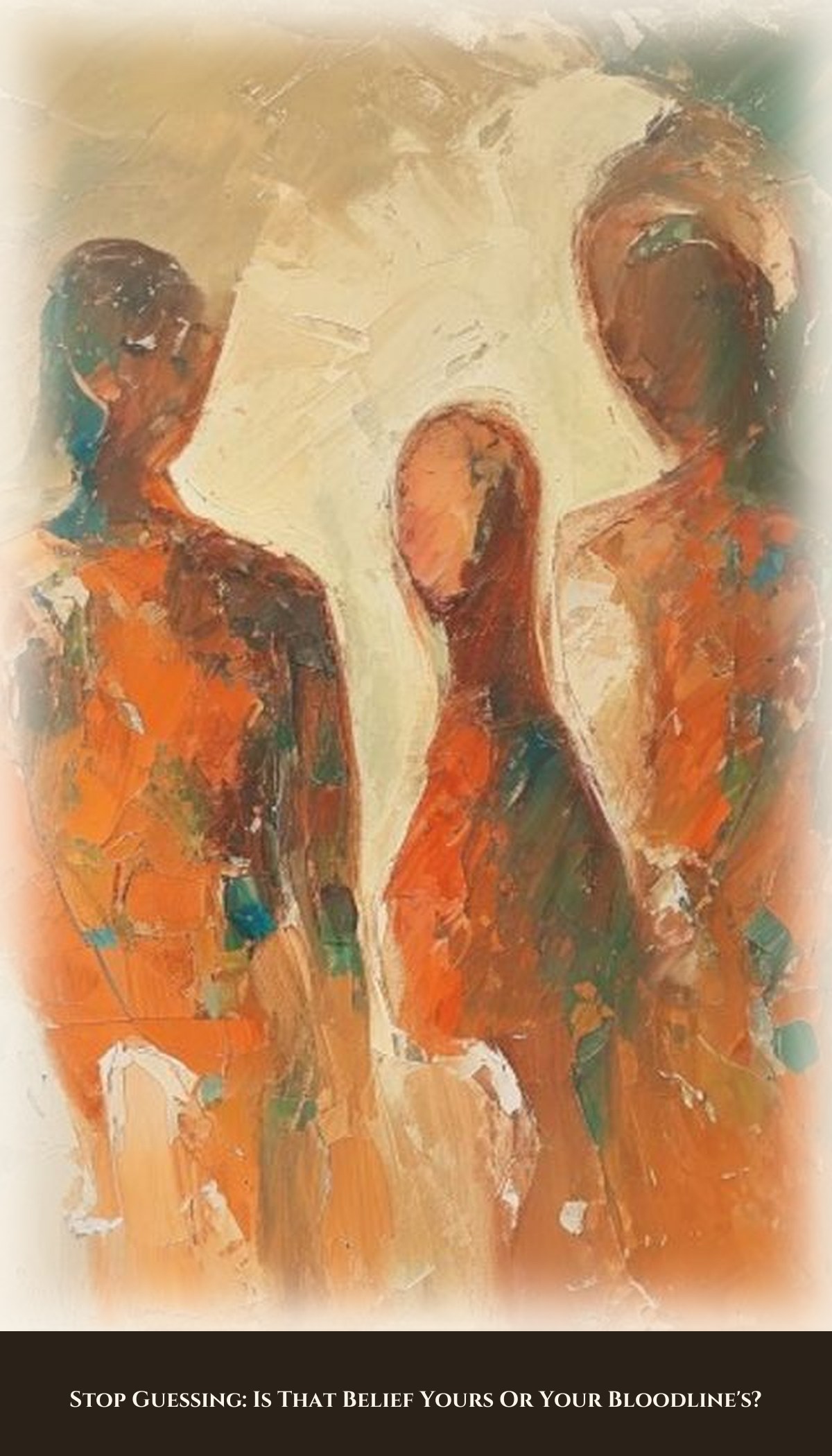
Stop Guessing: Is That Belief Yours Or Your Bloodline's?

Stop Guessing: Is That Belief Yours Or Your Bloodline's?

That knot in your stomach when a strong hunch arises, immediately followed by that nagging question: is this actually mine? Constantly wrestling with how to distinguish inherited beliefs vs intuition feels exhausting. It’s the constant internal debate over whether that powerful gut feeling stems from genuine intuitive knowing or just echoes of what you heard growing up. Trying to pinpoint the source of your gut feelings—that delicate dance between learned belief and innate wisdom—is a full-time job. You're deep in the weeds of distinguishing inherited programming versus intuition, making self-awareness in decision making feel less like an asset and more like a constant audit. The emotional resonance you feel is undeniable, but knowing if it’s truth or just well-worn familial script keeps you stuck right at the threshold.
Stop viewing your patterns as failures; they are simply structural wiring that needs mapping. That persistent pattern you feel unable to escape isn't a flaw in your character, but rather established circuitry within your intuitive development profile. When we look at the architecture of intuition itself, we see distinct markers for inherited programming versus genuine inner knowing. Your gut feeling validation techniques need to account for this distinction. Recognizing where those ingrained assumptions in intuition originated is key to distinguishing programmed thoughts from your authentic inner voice. This process of identifying innate vs learned beliefs allows you to access a deeper wellspring of self-awareness in decision making, moving beyond just reacting to the source of gut feelings and toward recognizing true intuitive knowing.
Most people mistake inherited programming versus intuition for a simple spectrum, assuming that if a feeling is strong enough, it must be truth. They struggle to distinguish inherited beliefs vs intuition because they lack the proper lens. The conventional wisdom treats every powerful emotion as gospel, failing to account for deeply ingrained assumptions in intuition. But the sphere framework illuminates this blind spot. It shows how what feels like an undeniable source of gut feelings is often just residue from societal conditioning, rather than genuine innate wisdom. You are finally seeing that simply having emotional resonance and truth is not enough; you need clarity on the source of your inner voice. Understanding the psychological roots of beliefs allows you to differentiate programmed thoughts from true intuitive knowing, moving beyond mere guesswork in self-awareness in decision making.
If you treat these whispers as mere echoes of what you were told, the natural consequence is that your decision-making remains colored by other people's histories and expectations. You will find yourself repeatedly making choices that feel safe because they are familiar, yet ultimately leave a subtle gap between where you actually want to go and where you believe you should go. Conversely, when you commit to testing these feelings against the evidence of your own experience, something shifts in your personal authority. You begin to notice patterns in your responses—the ones that genuinely resonate with a deeper truth about yourself versus the ones that only require nodding in agreement with what was said before. This clarity allows you to build a life structure based on your own internal compass, rather than one built upon inherited blueprints.
Book cover: Your hands know more. You are wired to feel the earth’s wisdom. Stop observing; start knowing through your palms. Own your touch.
You might find that the first signal of genuine intuitive knowing isn't a sudden flash, but a subtle pattern disruption in your usual thinking—a moment where logic stalls out and something quieter nudges you sideways. That feeling of cognitive dissonance, when it points toward an unexamined assumption about yourself or others, is often your intuition gently flagging inherited belief systems that no longer serve the reality you actually inhabit. But trust me, this is just the surface tension breaking. If you want to understand how to differentiate between cultural programming and deep personal knowing, pay attention to these areas: The Resonance of Physical Stillness; Identifying Core Narrative Echoes; And Mapping Emotional Triggers Against Childhood Milestones. Everything else requires a deeper look at the source code of your certainty.
Right now, you possess flashes of what feels like deep certainty, but that feeling remains ambiguous. You aren't quite sure if the voice guiding you is authentically yours or merely an echo from years of observation and expectation. There is a distinct space between simply having a strong hunch and possessing the absolute confidence to name that source—to know with undeniable clarity where your own core knowing begins and where external conditioning takes over. Imagine finally being able to separate those two streams so cleanly you never second-guess your inner compass again. That level of discernment, the ability to trust that gut feeling without reservation because you understand its origin completely, is what awaits you at the other side of this gap.
Take the next step toward clarity by exploring the complete guide at transformation.press.

Frequently Asked Questions

What is the main difference between an inherited belief and true intuition?

Inherited beliefs are often cultural or familial assumptions that feel automatic, while genuine intuition feels like a distinct, internal 'knowing' that surfaces without linear reasoning.

How can I test if a strong feeling is just conditioning rather than true insight?

Test the feeling by considering its origin: does it feel emotionally charged and resistant to logic (potential intuition), or does it simply confirm what you were taught to expect (potential belief)?

Are there specific exercises I can do to strengthen my intuitive knowing?

Practicing mindfulness, meditation, and journaling about gut feelings without judgment can help create space between the thought and your immediate reaction.

If I'm unsure, should I always trust my intuition over expert advice?

Intuition is a guide, not a replacement for expertise. Use it to question assumptions or suggest paths to explore further with established knowledge.

How does emotional regulation help distinguish between the two?

Inherited beliefs often trigger strong, immediate emotions tied to fear or obligation; true intuition tends to bring a sense of calm clarity, even if the insight itself is challenging.